
I moved to Boulder for the mountains.
I stayed for the wind.
That sounds wrong. Nobody stays for the wind. The wind is the thing you tolerate—the thing that blows your trash can down the street, dries out your skin, and makes January feel like a personal attack. The wind is the cost of living in a place with views.
But I've been here long enough to notice something: the wind is not the enemy. The wind is the teacher. And if you pay attention to it—really pay attention—it will tell you everything you need to know about how your house should work.
The building code doesn't teach this. The code tells you how to keep the roof on. It doesn't tell you where to put the front door, or how to orient the windows, or why one side of your house feels like a wind tunnel while the other side feels like a tomb.
The wind tells you all of that. You just have to listen.
The Lesson of the Flatirons
The Flatirons are not a single mountain. They're a series of tilted sandstone slabs that rise out of the foothills like the spines of buried giants. They face east. They catch the morning sun. They look like they're leaning forward.
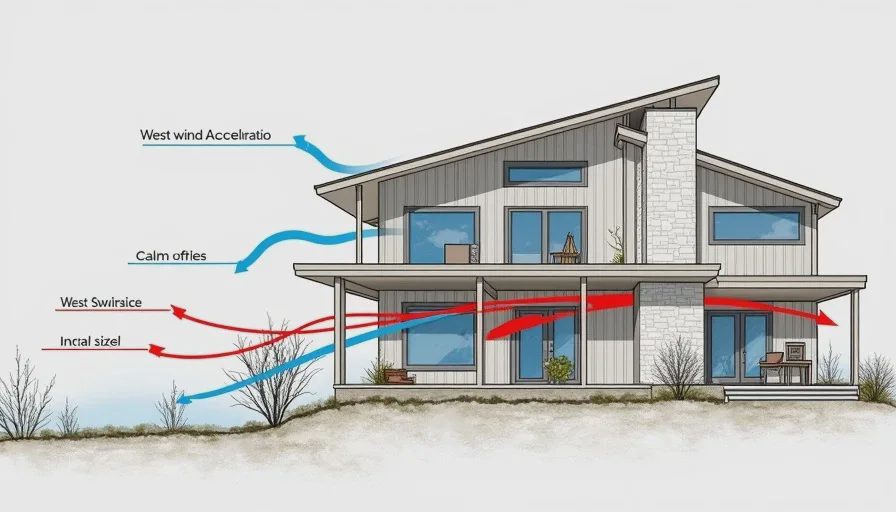
The wind comes from the west. It hits the mountains and does three things.
First, it accelerates. The air is forced upward by the slope. It speeds up. The compression creates lift. The wind on the west side of the Flatirons is faster than the wind in the plains.
Second, it swirls. The mountains create turbulence. The wind doesn't flow straight—it eddies, it curls, it spins. The air moves in patterns that are not predictable, not linear, and not comfortable.
Third, it calms. On the east side of the Flatirons, the wind drops. The mountain blocks the flow. The air settles. The east side is sheltered, warm, and still.
Every house in Boulder is in one of these three zones: the acceleration zone, the swirl zone, or the calm zone.
Most people don't know which zone they're in. They just know their house is drafty, or their yard is windy, or their bedroom is too still. They don't connect the wind to the architecture.
They should.
The Code Doesn't Care
The building code cares about structural loads. It cares about the roof staying on. It cares about windows not blowing in. It cares about the door being able to open in a hurricane.
The building code does not care about comfort. It does not care about drafts. It does not care about how the wind feels on your neck when you're trying to have dinner. The code is about survival. Comfort is a separate conversation.
The code assumes the wind is a force to be resisted. A problem to be engineered away. A load to be calculated.
The wind is not a problem. The wind is a pattern. It's a pattern that you can learn, anticipate, and work with.
The code doesn't teach pattern recognition. The mountains do.
Three Things the Wind Taught Me
One: The West Side Is Not the Enemy
The west wind is cold. It's fast. It's relentless. Most people put their living rooms on the south side of the house to catch the sun. They put their bedrooms on the east side to catch the morning light. They put their kitchens on the north side because the view is better. And they put their garages on the west side to block the wind.
That's a mistake.
The garage is a buffer. It's a windbreak. It's a way to slow the wind down before it hits the house. If you put the garage on the west side, you're using it to protect the rest of the house. If you put the garage on the south side (for the sun) or the east side (for the view), you're sacrificing the wind protection.
I learned this from watching the Flatirons. The mountains protect the east side. They take the wind and slow it. The houses on the east side of the foothills don't need a windbreak—they have a mountain.
The houses on the west side of the foothills don't. They need a buffer. A garage. A fence. A row of trees. Something that takes the wind before it takes the house.
Two: The Swirl Zone Is a Design Problem
The swirl zone is the hardest one to diagnose. The wind doesn't come from one direction. It comes from everywhere. It enters the house through gaps and cracks. It moves in unpredictable patterns. It creates pressure differences that make doors stick and windows rattle.
Most people in the swirl zone think they have a draft issue. They add weatherstripping. They add caulk. They add insulation. They fight the wind with materials.
The wind doesn't care about materials. The wind cares about path. If the wind can find a path, it will take it. If you block the path, it will find another.
The swirl zone needs a different approach: confusion. You confuse the wind by giving it multiple paths. You open windows on both sides of the house. You create cross-ventilation. You let the wind move through the house instead of fighting it.
The wind that moves through the house is the wind that doesn't get stuck. The wind that gets stuck is the wind that causes problems.
Three: The Calm Zone Is a Gift
The east side of the house is the calm side. The mountain protects it. The wind slows down. The air settles.
Most people don't think about the calm side. They think about the view. They put their bedrooms on the east side because they want the morning sun. They put their living rooms on the east side because they want the view of the mountains. They put their kitchens on the east side because they want the light.
But the calm side has a different gift: stillness. The east side of the house is where you can sit without the wind. It's where you can open the window without the draft. It's where you can relax.
I put my bedroom on the east side. Not for the light—for the calm. The wind is a problem at night. The wind wakes you up. It rattles the windows. It changes the pressure in the room.
The east side of the house is the side that lets you sleep.
The Front Door Test
I have a test for every house I walk into.
I stand at the front door and listen. Not with my ears—with my body. I feel the wind. Where is it coming from? Is it hitting the door directly? Is it hitting the side of the house? Is it swirling around the corner?
If the wind is hitting the door directly, the house is fighting the terrain. The door is a wind catcher. Every time you open it, the wind enters. Every time you close it, the wind pushes against it. The house is in a constant state of pressure.
If the wind is hitting the side of the house, the house is in the swirl zone. The door is protected. The wind is moving around the house, not through it.
If the wind is not hitting the house at all, the house is in the calm zone. The terrain is protecting it. The house is settled.
The front door is the house's first interface with the wind. The way the wind hits the door tells you everything about the house's relationship with its terrain.
The Kyoto Connection
In Kyoto, I learned something about wind and architecture.
The old houses have "wind bells"—metal or glass bells that hang from the eaves. They're not decoration. They're a warning system. The wind bell tells you when the wind is coming. It changes pitch as the wind changes direction.
The architecture of the old houses is designed to work with the wind. The eaves are deep. The windows are small on the windward side and large on the leeward side. The doors are on the sheltered side of the house.
They didn't fight the wind. They listened to it. The wind bell was a diagnostic tool.
The June Test
June has a wind chime in her room. Not a fancy one. A cheap one from a garage sale. She hung it from her ceiling above the window.
I asked her why she put it there.
"Because I can hear the wind."
"What do you hear?"
"I can hear if it's windy outside. I can hear if I should close the window."
The wind chime is a diagnostic tool. It tells June what the wind is doing. It's the simplest form of environmental feedback.
I didn't teach her that. She figured it out on her own.

No notes yet — write the first.