Let's start with the obvious: I am not a sleep doctor.
I am a guy who has stood in hundreds of bedrooms and watched people describe their insomnia like it's a personal failing. They try magnesium. They try blue-light blockers. They try white noise machines and weighted blankets and podcasts that tell them to imagine a calm forest. They do everything right. And they still wake up at 3:00 a.m. with a racing heart.
I stand there, look at the bed, and say: "Can I move this?"
And then I do. And then they sleep.
Not because I'm magic. Because the bed was in the wrong place.
The Bed Is Not a Sofa
Here's the first thing I learned from fourteen years of drawing floor plans:
Architects place beds like they're placing sofas. Against the longest wall. Centered. Symmetrical. It looks balanced in the drawing. It looks terrible for sleeping.
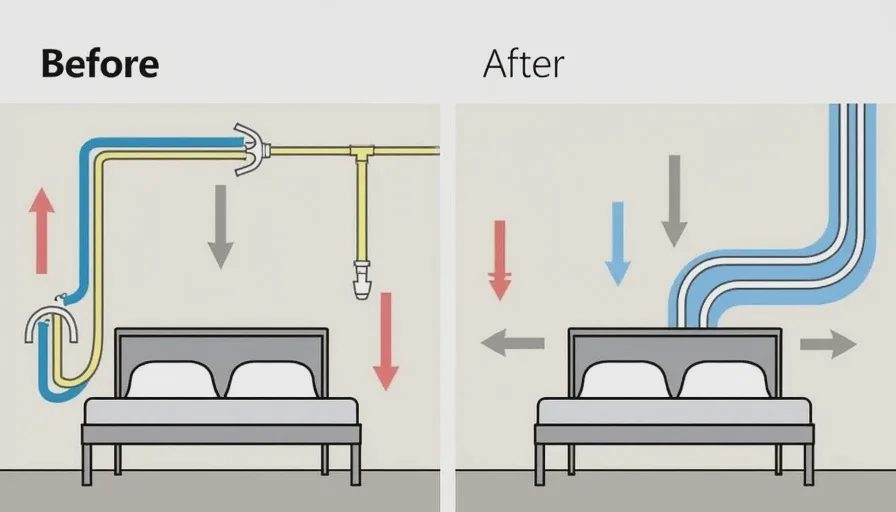
A sofa wants a wall behind it because you're sitting up, facing outward, and the wall gives you back support and a sense of enclosure. A bed is different. You're lying down. Your head is at one end, your body is exposed, and the wall is behind your head — not behind your back.
The problem is what happens behind the wall.
The Wall Behind the Wall
I have this conversation at least once a week.
"My bedroom is on the second floor. The bed is against the interior wall."
"What's on the other side?"
"The bathroom."
"The one you use at 3:00 a.m.?"
"Yes."
"The one with the exhaust fan that cycles on with the light, the one with the pipes that expand and contract when the heat kicks on, the one with the toilet that fills with water and sends a low-frequency vibration through the framing?"
Long pause.
"I didn't think of that."
You're sleeping against a wall that is transmitting sound, vibration, and temperature changes from an adjacent room. Your body registers these things. Your conscious mind doesn't. But your nervous system does. And your nervous system responds with the only tool it has: hypervigilance.
The same applies to:
The garage (fridge compressors, car doors, the whole house shaking when the garage door goes up)
The kitchen (ice maker, water filtration, sink drainage)
The hallway (foot traffic, doors opening, the dog padding past at 2:00 a.m.)
The exterior wall (temperature extremes, wind, traffic, that one neighbor with the loud exhaust)
A bed against a shared wall is a bed that shares its problems.
The Dead-Air Zone
Let's get physical.
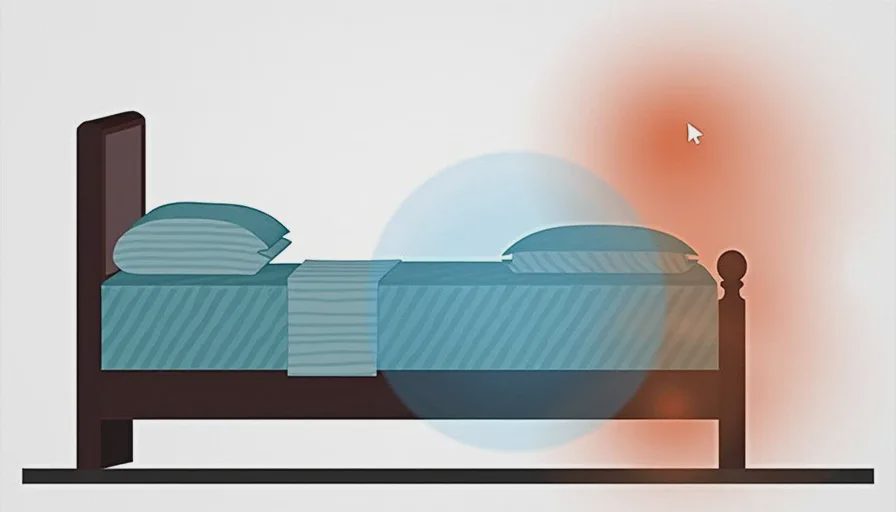
In every room, there is a zone of still air. It's usually in corners, behind furniture, and anywhere circulation doesn't naturally flow. In a bedroom, the dead-air zone is almost always behind the headboard.
Why? Because the headboard is a vertical plane blocking the room's natural airflow. Air moves across the room, hits the headboard, and stalls. The space between the headboard and the wall (if there is any) becomes a pocket of unmoving air.
You can't smell it. You can't see it. But you're breathing it. Stale air. The stuff that's already been exhaled by the room's occupants, mixed with dust mites, off-gassing from the mattress, and whatever the dog rolled in.
That's not a health crisis. But it's also not fresh. And fresh air is what your brain needs to drop into deep sleep. Stale air keeps you in light sleep — the kind where every sound registers, every temperature change wakes you, and you wake up feeling like you haven't slept at all.
Here's the test: put your hand between the headboard and the wall. Feel the temperature. Is it warmer than the rest of the room? That's the dead-air zone. Your head is two feet away from it. You're soaking in the heat and the stagnation all night long.
Fix: Move the bed six inches off the wall. Not a foot. Six inches. Just enough to let air circulate behind the headboard. The difference is immediate. Your head is no longer in the dead zone. The room is now part of the sleep system, not an obstacle to it.
Windows: The Alignment Problem
The second most common bedroom problem I see: the bed is aligned with a window.
Not necessarily pointing at it. Aligned with it. The headboard is on one wall, the window is on the opposite wall, and the bed sits directly in the sightline.
Here's the physics: windows are thermal weak points. They're where heat leaves and cold enters. In winter, you can feel the temperature gradient from the window to the rest of the room. In summer, you can feel the solar gain. If your body is in that sightline, you're the sensor.
You might not consciously notice the temperature swing at 2:00 a.m. But your body notices. It adjusts. It reduces blood flow to your extremities. It prioritizes core warmth. And when your body is busy managing temperature, it's not busy doing the things it does in deep sleep: memory consolidation, cellular repair, emotional regulation.
The old feng shui texts say "don't point your bed at a door or window." They didn't know what thermal radiation was. They just knew it felt wrong. They were right.
Fix: Move the bed so it's not in the primary sightline of the window. Put it at a 45-degree angle. Put it on a different wall entirely. The window should be in your peripheral vision, not in your direct line of sight.
The Magnetic Interference Thing
I hesitate to include this because it sounds like the kind of thing I'm supposed to debunk. But I've measured it too many times to ignore.
Some walls contain electrical wiring. When you sleep against a wall with a lot of active current running through it — especially the wall with the breaker panel or the main feed — you're lying in an electromagnetic field. The field itself is weak. But it's also constant. And constant low-frequency signals are what the brain's sleep architecture interprets as "vigilance needed."
Is it dangerous? Probably not. Is it disruptive? For some people, yes. And I know it's disruptive because I've moved beds off electrical walls and watched people sleep better within 48 hours.
Again: I can't prove the mechanism. I can only point to the data. People sleep better on walls with no electrical activity behind them. That's a room diagnosis, not a miracle claim.
The June Exception
I should tell you a story.
June is nine. June doesn't care about thermal gradients or dead-air zones. June is immune to my architectural logic.
Last year, she moved her bed to face her window. Directly. Perfectly aligned. I walked in and felt my entire professional identity twitch.
"June, why did you put your bed there?"
"Because I like to see the trees when I wake up."
"That's not good for your sleep."
"I sleep fine, Dad."
She was right. She slept fine. Kids are thermoregulators. They sleep anywhere. Their nervous systems are flexible. They don't have thirty years of cortisol accumulated in their bodies.
I don't recommend adult bedrooms for children. I recommend them for adults. And if you're an adult and you're reading this and you're sleeping poorly, start with the bed. Move it before you buy anything. Move it before you change your sheets. Move it before you try the magnesium.
You might just be sleeping in the wrong place.
The 3:00 a.m. Wake-Up Test
Here's a reliable indicator.
Do you wake up between 3:00 and 4:00 a.m. and struggle to fall back asleep? That's not random. That's the cortisol shift. Your body is preparing to wake up. It releases cortisol. In a healthy sleep system, the cortisol is low enough that you sleep through it. In a disrupted sleep system, the cortisol crosses the threshold and wakes you.
The disruption is almost always environmental. Temperature drop. Sound. Air movement. Or (most commonly) your body shifting position and finding itself in a dead-air zone, triggering a subtle stress response that tells your brain: something's wrong, wake up, we need to check.
If you wake up at 3:00 a.m., do a room scan. Not in the moment — you're too groggy. Do it the next morning.
Is your headboard against a shared wall?
Is your bed in the sightline of a window?
Is there space behind the headboard?
If you said yes to any of these, you've found your 3:00 a.m. guest. It's not sleep paralysis. It's not the witching hour. It's physics.
The Fix
Here's the order I recommend:
Move the bed. Put it on a wall that isn't shared with a bathroom, kitchen, garage, or hallway. Exterior walls are better than interior walls. Yes, they're colder. You have a blanket. Put the blanket on.
Pull the bed six inches off the wall. Air behind the headboard changes everything. This is the cheapest, fastest, most effective fix in my entire toolkit.
Take the bed out of the window's direct sightline. At an angle is fine. Perpendicular is better. The window should be something you can see if you turn your head. Not something you're looking at while lying still.
Check the wall for electrical sources. If you can't move the bed, at least turn off the breaker for that wall at night. (If you can't do that, you have bigger problems than sleep.)
If you've done all of this and you're still waking up at 3:00 a.m. — see a sleep doctor. Because I'm an architect, not a physician. And when I run out of room-based explanations, I'm just a guy with a tape measure. A sleep doctor has more tools than I do.


No notes yet — write the first.