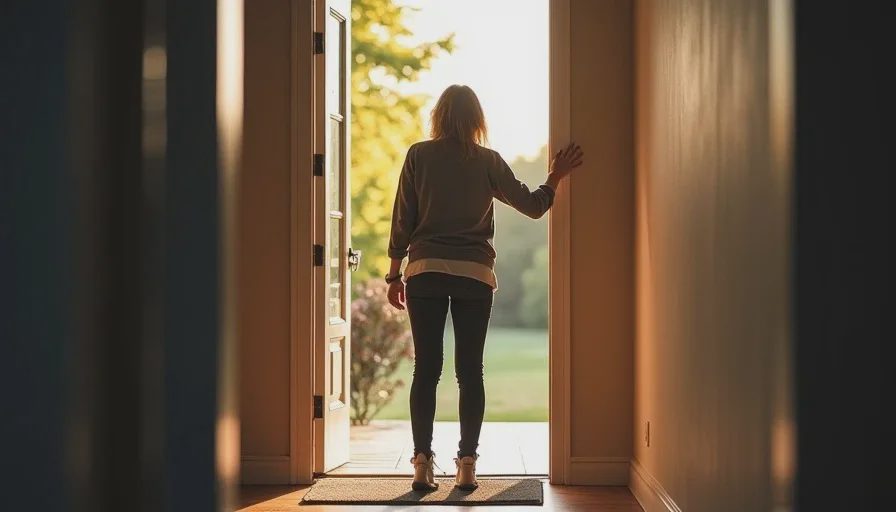
I have a confession.
I can't walk into a house without mentally drawing its floor plan. Restaurants, friends' houses, the dentist's waiting room — if you see me tracing lines on a table with my finger, I'm diagnosing the corner behind the potted plant. It's not a choice. It's a professional deformation.
But the diagnosis always starts in the same place. The front door.
Not because it's the most important room. Because it's the first room. And the first room tells you everything about the rest of the house the way a handshake tells you everything about the rest of the conversation.
Here's what I look for in the first five seconds.
The Handshake
The front door is your house's mouth. It opens, it closes, and in the moment between, something passes through. Air, light, sound, and every guest who ever crosses the threshold.
If the entryway is cramped, you've just told every visitor: this house doesn't have room for you. If it's cluttered, you've told them: this household is overwhelmed. If it's empty — a bare floor, a blank wall, no place to stop — you've told them: keep moving, there's nothing here for you.
The entryway is the handshake. And like a handshake, it should be firm, warm, and brief. Too long and it's awkward. Too short and it's dismissive. Too weak and no one trusts what comes after.
What I See When I Walk In
First: the sightline.
I stand on the doormat and don't move my feet. I let my eyes go wherever they want to go.
If they go straight through the house and out a back window, the house is telling me to leave before I've arrived. There's no stop, no pause, no acknowledgment of the threshold I just crossed. That house doesn't welcome. It transmits.
If they hit a wall three feet in front of me, the house is telling me to stop, but it's not telling me why. A wall that close is a wall that says this is all you get. It's the architectural equivalent of a closed expression.
If they land on a piece of furniture — a console table, a bench, a piece of art — the house has just introduced itself. Here's who we are. Here's what we care about. Here's where you can pause before you step further in.
The best entryways give you something to look at that isn't the rest of the house. A mirror that reflects light, not your face. A lamp that says warmth. A single object that tells you something about the people who live here — their taste, their humor, their sense of what matters.
If I can see your living room from the front door, you've shown me the whole movie in the first frame. There's no suspense. No revelation. Just a flat, undifferentiated experience that I've already processed before I've taken my coat off.
Second: the light.
I look at the entryway's light source. Not the kind — the source.
If it's an overhead fixture, the house is saying we value efficiency. Nothing wrong with efficiency. But an overhead light in an entryway is like a handshake that ends too quickly. It's functional. It's not memorable.
If it's a table lamp, a wall sconce, or (rarest of all) a floor lamp that illuminates a corner, the house is saying we understand mood. That light is lower, warmer, and it creates a cone of welcome that you walk into before you've said hello.
If there's no dedicated light at all — just the spill from the living room or the kitchen — the house is saying the entryway isn't important. And if the entryway isn't important, why should the guest feel important?
Third: the clutter.
I look down. I always look down.
If there are shoes scattered across the floor, the house has a boundary problem. The outside is coming in, and no one's decided where it stops. If there's a pile of mail on a table, the house is carrying mental weight that hasn't been put down. If there's a coat rack that's overflowing, the house has more obligations than it can hold.
Clutter in the entryway is the house's metabolism. It shows you how the household processes (or doesn't process) the daily influx of stuff. A tidy entryway doesn't mean a tidy house. But a cluttered entryway almost always means a household that never quite catches up.
The Two-Foot Rule
Here's a standard I stole from a client years ago.
She told me she wanted to be able to stand in her entryway and look down the hall to the master bedroom door. Not because she needed to see it — because she needed to know the path between them was clear. She wanted to feel that her house had a spine.
So I measured the width of her hallway and asked a question I still ask myself in every entryway: is there room for two people to pass comfortably?
If the entryway can't accommodate two bodies moving in opposite directions, it's too small. Not for code — for energy. A house that can't accommodate a handshake and a goodbye in the same space is a house that's always slightly uncomfortable with its own comings and goings.
Try it in your own entryway. Stand in the doorway. Have someone walk toward you. If one of you has to turn sideways, that's a problem. Not a renovation problem. A recognition problem. The space is telling you something. You're just now hearing it.
What Your Entryway Is Saying About You
I'll be blunt.
If your entryway is a dumping ground, your house is a dumping ground. The rest of the house may look pristine. But the entryway is the truth. It's where you drop your guard — literally. It's where the outside transitions to the inside, and if that transition is chaotic, the rest of the house is just a well-decorated cover.
If your entryway is empty, your house is withholding. You're not telling visitors who you are. You're not telling them to stay. You're just letting them in and hoping they figure it out.
If your entryway is warm — a lamp, a seat, a surface, something that smells like you and looks like you and feels like you — your house is ready. For visitors, for you, for the energy that comes through that door every day.
Your front door opens. Something comes in. What does it find?
The Fix, In Order of Importance
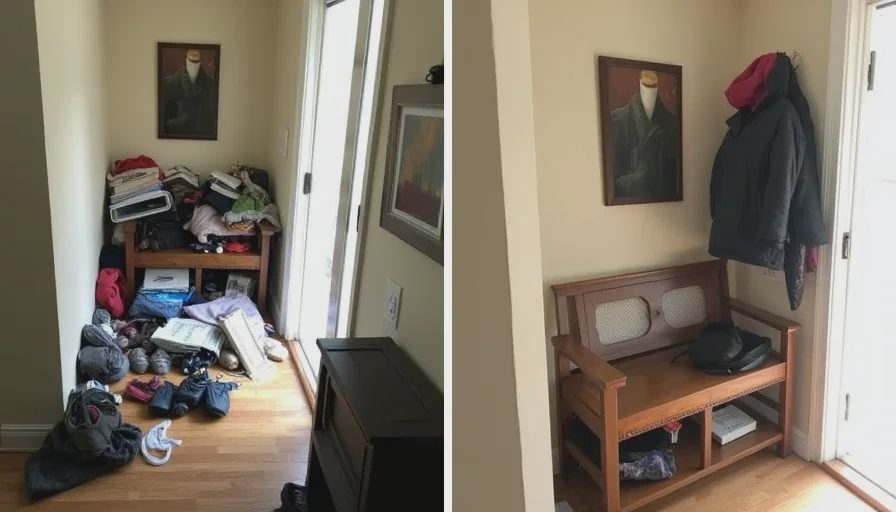
One: Give it a surface. A console table, a shelf, a bench. Something that says you can put something down here. That includes your keys, your bag, your guard.
Two: Give it light. A lamp at eye level or below. Overhead light is for utility. Eye-level light is for hospitality.
Three: Give it a sightline. Something to look at that isn't the rest of the house. A piece of art. A mirror (but not facing the door — that sends energy back out). A plant. Something that says we've thought about this moment.
Four: Clear the floor. Shoes go in a basket or a cabinet. Mail goes to the kitchen or the office. The floor should be a path, not a storage surface.
Five: Let it breathe. If you can't stand in your entryway and take a full breath without hitting something with your elbow, it's too full. Give it room to be what it's meant to be: a pause, not a storage room.
June was the one who taught me this, actually.
When we first moved to Boulder, our entryway was a disaster. Shoes, backpacks, three different jackets, a stack of mail that seemed to reproduce overnight. I was too busy thinking about the rest of the house to notice what was happening at the front of it.
June looked at the pile one afternoon and said, "Dad, it looks like the house is trying to eat its own shoes."
She was right. I cleared it out that weekend. Took everything out. Put a bench in. A lamp on the bench. A small bowl for keys.
The rest of the house didn't change. But the house felt different. Because the first thing anyone saw — including us, every single day — was a place that was ready for them.
Not a place that was overwhelmed.
A place that was ready.

No notes yet — write the first.