
I spent five years in Kyoto.
Five years of walking through gardens that were designed to be seen from one specific spot, from one specific angle, at one specific time of day. Five years of noticing that the Japanese don't build gardens—they frame them. Five years of standing in rooms that felt twice as big as they actually were, because the window was aligned with a view that went on forever.
It took me about four of those years to understand what was happening.
The Japanese have a concept called shakkei—borrowed scenery. It means using the landscape beyond your property as part of your garden. You don't build a wall to block the neighbor's view. You build a wall that frames the mountain in the distance. You don't plant trees to hide the street. You plant trees that create a foreground for the hills beyond.
The mountain isn't yours. But the view of it is.
I spent those five years thinking this was a beautiful aesthetic. A poetic way of seeing the world. Something Japanese and therefore exotic and therefore not applicable to my life in Colorado.
Then I moved back to Boulder. I looked out my living room window. I saw the Flatirons. And I realized I'd been wrong.
Shakkei isn't poetic. It's practical. It's a way of making a small room feel large. A way of connecting the inside to the outside. A way of giving a house a horizon.
It's also the single most useful thing I learned in Kyoto.
Borrowed Scenery: How It Works
The principle is simple: you don't need to own the view. You just need to see it.
In Kyoto, the borrowed scenery is usually a mountain, a temple, or a distant hill. The garden is designed so that when you stand in a certain spot—a doorway, a window, a seated position on the tatami—you see the garden and the mountain beyond it. The garden is the foreground. The mountain is the background. The two become one composition.
The same principle applies to your living room.
You don't need to own the Flatirons. You just need to frame them. If your window is aligned with a view of the mountain, your room feels like it extends all the way to the peak. The room is no longer a box—it's a corridor that ends in geology.
The key is alignment. The window has to be positioned so that when you're in the room, the view is visible. Not from every angle—from the right angle. The place where you sit. The place where you stand. The place where the room wants you to be.
Most American houses have windows that face the view. That's not enough. The window has to frame the view—to crop it, to focus it, to make it intentional. A picture window that shows everything shows nothing. A window that shows just the mountain—just the peak, just the ridge—shows the world.
The Practice in My Living Room
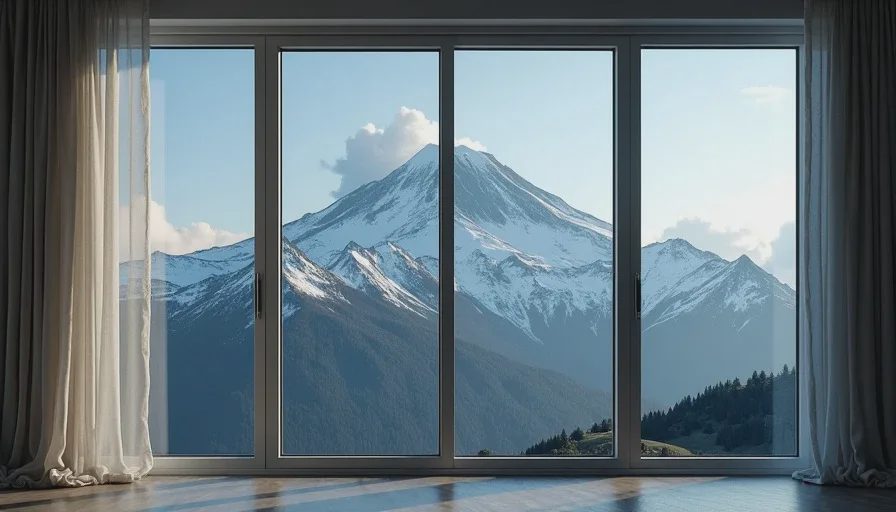
My living room has a large south-facing window. It looks out at the Flatirons. The view is spectacular. It's also too big.
I spent years thinking the size of the window was the point. The bigger the window, the better the view. The more glass, the more connection to the outside. That's what I was taught in architecture school.
The Japanese taught me something different: a view is not about the amount of glass. It's about the proportion. A small window that frames the right thing is better than a large window that frames everything.
I hung a curtain. Not a heavy one. A light linen curtain that I could draw across the window, narrowing the view. When it's fully open, I see the whole mountain. When it's half-closed, I see just the peak. The peak is better. The peak is focused. The peak is intentional.
The room feels bigger when I limit the view. Not smaller. Bigger. Because my eye has somewhere to land. It's not searching the whole mountain—it's settling on the part that matters.
The Framed Threshold
The Japanese have another concept: kakushi—hidden or framed thresholds. A doorway that's partially obscured. A path that turns before you see the destination. A garden that reveals itself in stages.
The threshold is the transition between inside and outside. In Japanese architecture, it's often treated as a composition. The doorway itself is a frame. The view beyond it is the content.
I translated this into a design for my own house.
The door from the hallway to the living room was a standard American door. Open. Full-height. No transition. You walk through it and you're in the room. No pause. No moment of arrival.
I replaced it with a doorway that was slightly narrower. I added a small bench on the inside. I put a lamp on the bench. The lamp is not bright—it's warm. It's not for reading—it's for transitioning. You step through the doorway, the lamp is lit, you pause for a moment, and then you enter the room.
The doorway is now a threshold. It's not just a passage—it's a moment. A moment of arrival. A moment of separation between the hallway and the living room.
The living room feels bigger because the threshold is intentional. The act of entering is slower. The room has a sense of arrival.
The Connection to Terrain
Borrowed scenery works because it connects the inside to the outside. The room becomes part of the landscape. The mountain becomes part of the room.
That connection is the most valuable thing a room can have. Not because it's beautiful—because it's grounding. A room that's connected to its surroundings is a room that doesn't feel sealed. It doesn't feel like a box. It feels like a place.
The terrain in Boulder is dramatic. The mountains are close. The plains are open. The sky is big. A room that doesn't acknowledge that terrain is a room that's missing something. A room that frames it is a room that's complete.
The Japanese Garden Protocol
Here are the three things I brought back from Kyoto.
One: A View Should Be Framed, Not Revealed.
Don't show the whole mountain. Show the best part of the mountain. Crop it. Focus it. Make it intentional.
How to do it:
Use curtains or blinds to narrow the view.
Place the window so the view is visible from the room's primary seating position.
Use trees, plants, or a pergola to create a foreground that frames the view.
Don't put anything in the window itself—let the glass be the frame.
Two: A Threshold Should Be Intentional.
The act of entering a room should be a moment. Not a passage. A transition.
How to do it:
Widen the doorway or narrow it to create a sense of compression and release.
Add a light that's warm and low.
Put a surface—a bench, a shelf, a table—just inside the doorway.
Make the threshold a pause, not a passage.
Three: The Inside Should Acknowledge the Outside.
The room should be aware of the terrain. Not by looking at it—by responding to it.
How to do it:
Use materials that echo the outside—wood, stone, natural fiber.
Orient the room toward the most significant feature of the landscape.
Keep the sightlines clear. Don't block the view with furniture.
Let the outside be the room's background, not its competitor.
What I Learned From a Garden in Kyoto
There's a garden I visited many times. It's small. A room, really. A single room with a window that opens onto a courtyard. The courtyard has a single tree. The tree is pruned so that it frames the view of a distant mountain.
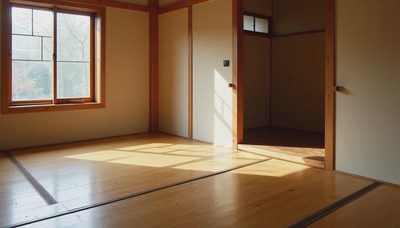
The room is tiny. Ten tatami mats. Maybe 180 square feet. But it feels like a cathedral.
Because the window is the right size. The tree is the right height. The mountain is the right distance. The room doesn't end at the walls—it ends at the peak.
I spent hours in that room. Not doing anything. Just sitting. Looking. Letting the room do what it was designed to do: connect me to the landscape.
When I came back to Boulder, I realized my living room was doing the opposite. It was showing me the mountain but not connecting me to it. The window was too big. The view was too broad. The room was a viewer, not a participant.
I changed it. Slowly. Small interventions. A curtain. A bench. A lamp. A doorway that became a threshold.
The room now feels bigger. Not because it's larger—because it's connected. The mountain is in the room. The room is in the mountain.
The June Test
June sat in the living room after I made the changes. She looked at the window. She looked at the mountain.
"Dad, why does it feel bigger?"
"Because you can see only part of the mountain."
"That doesn't make sense."
"I know. But it works."
She looked again. She didn't argue.
She's nine. She knows when something feels right.c
No notes yet — write the first.