
I once gave my sister a very heavy stone bowl for her birthday.
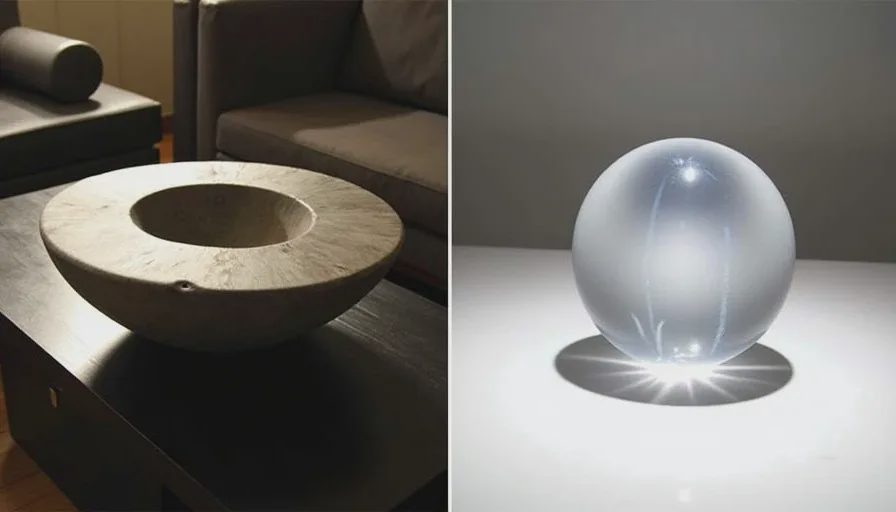
It was beautiful. Hand-carved. Soapstone. The kind of object that costs more than you want to admit and weighs about as much as a medium-sized dog. I was sure she would love it.
She put it on her coffee table. It sat there for three years. I visited her apartment twice a year and watched that bowl collect dust, get moved to the floor, get moved to the windowsill, get moved back to the coffee table. It never quite landed.
One day I asked her about it.
"I don't know what to do with it," she said. "It's too heavy for the table. It makes the whole room feel like it's carrying something."
She was right. The bowl was an anchor. And her room didn't need an anchor. It was already grounded — heavy furniture, dark wood, bookshelves full of actual books. The room was solid. It needed lift. It needed something that floated, caught light, and reminded the space it had a ceiling.
I gave her a glass sculpture the next year. Small. Translucent. Almost invisible. It caught the afternoon sun and threw a prism across her wall.
She kept it on the coffee table. She still has it.
The stone bowl lives in my garage now. It's a lesson I keep around to remind me: the wrong gift isn't just wasted money. It's weight the room didn't ask for.
The Two Jobs of a Gift
Every room has a hidden personality trait. Some rooms are heavy. They feel secure, grounded, substantial. They're the rooms you want to sink into. They're also the rooms that can feel oppressive, fixed, and slow to change.
Other rooms are light. They feel airy, open, transient. They're the rooms that let you breathe. They're also the rooms that can feel temporary, insubstantial, and unanchored.
A good gift is one that complements the room's existing energy. An anchor goes in a room that's too light. A lift goes in a room that's too heavy. A gift that matches the room's energy just doubles the problem.
The stone bowl was a match. My sister's room was already heavy. The bowl made it heavier. The glass sculpture was a contrast. It gave the room something it couldn't give itself.
The art of the spatial gift is knowing which one a room needs before you buy anything.
How to Tell If a Room Needs Anchoring or Lifting
Here's the test I do before I shop for anyone's house.
I walk into the room and I ask myself one question: Does this room make me want to sit down and stay, or does it make me want to move through and keep going?
If the answer is "sit down and stay," the room is already anchored. It doesn't need more weight. It needs something that keeps the energy moving — a lift.
If the answer is "move through and keep going," the room is too light. It needs something that stops the eye, slows the breath, and gives the energy somewhere to land — an anchor.
Here are the diagnostic details I look for:
Signs a room is too heavy:
Dark walls, dark furniture, dark floors
Overstuffed seating
Low ceilings or heavy ceiling beams
Lots of wood grain and natural texture
Sound that doesn't echo (all surfaces are absorbing, not reflecting)
A sense that the room is cozy but slightly suffocating
Signs a room is too light:
White walls, white furniture, reflective surfaces
Sparse furniture
High ceilings or open sightlines
Lots of glass and metal
Sound that echoes (hard surfaces everywhere)
A sense that the room is clean but slightly uncomfortable
Both can be beautiful. Both can be problems. The gift you choose should address the problem, not amplify it.
Objects That Anchor
An anchor doesn't have to be heavy. It just has to be present. It has to stop the eye, slow the movement, and give the room a center of gravity.
Here are the anchors I reach for most often:
A Large Book
Not a decorative book. A read book. Something with a spine that's cracked, pages that are worn, weight that's earned. Put it on a coffee table, an ottoman, a shelf that's too empty. It's not the book itself that anchors the room. It's what the book represents: something that took time to complete.
A Solid Wood Object
A cutting board. A bowl. A candlestick. Something that was once a tree and still remembers what that felt like. Wood anchors because it's organic, imperfect, and heavy enough to remind you that nature is real. Put it where the light hits it. The warmth will do the rest.
A Ceramic Vessel
Not a vase. A vessel. Something that could hold water, even if it never does. Ceramic grounds because it's made of earth, fired in fire, and unchanged by time. A ceramic bowl on a white table changes the table's entire presence.
A Rug
Not a trend rug. A rug with weight. Wool, not polyester. Deep color, not pale. A rug anchors a room by defining its boundaries. A room without a rug is a room without a floor. A room with the right rug has somewhere to land.
A Heavy Metal Object
Brass, copper, cast iron. Something that requires two hands to lift. Metal anchors because it doesn't pretend to be anything other than what it is: mass, density, presence. A brass candleholder on a minimalist table gives the room a center. Not because it's beautiful. Because it's solid.
Objects That Lift
A lift doesn't have to be light. It just has to be porous. It has to let light pass through, let the eye move past it, let the room breathe.
Here are the lifts I reach for most often:
A Glass Object
A sculpture. A carafe. A paperweight. Anything that light can travel through. Glass lifts because it's transparent, delicate, and insubstantial. It brings the ceiling down and the floor up. It makes a heavy room feel less committed to the ground.
A Mirror
Not a mirror that reflects a dead corner. A mirror that reflects a window, a light source, a view. A well-placed mirror lifts a room by giving it depth. It tells the eye: keep going, there's more here than you thought.
A Plant That Reaches Up
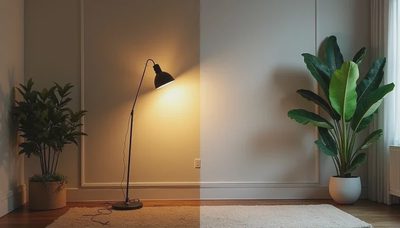
Not a trailing plant. A standing plant. Snake plant. Fiddle leaf. Something that insists on verticality. A plant that reaches up lifts the room's energy by reminding you that the ceiling exists. It's a conversation between the floor and the roof.
A Light Sculpture
A mobile, a chandelier, a pendant light. Something that hangs. The moment an object leaves the ground, the room lifts. Gravity is the room's default state. Anything that defies it is a gift.
A Pale Textile
A throw blanket. A cushion cover. A curtain that isn't thick. Something that's light in weight and light in color. Textiles lift because they're soft, movable, and temporary. A heavy room needs something that won't stay in the same place for too long.
The Room as Client
Here's a story.
I had a client in Denver. High-end apartment. All white. Hardwood floors. Floor-to-ceiling windows. The room was pristine. It was also impossible to be comfortable in.
She had a conversation area in the corner: two white chairs, a white coffee table, and a white rug. The chairs were beautiful. Nobody sat in them.
I asked her what she wanted the room to feel like.
"Calm," she said. "I want people to feel calm when they come in."
I told her she had a lifting problem. The room was so light it was weightless. There was nothing to hold onto. People felt disoriented, not calm. The chairs were beautiful, but they didn't invite sitting. They invited looking.
I recommended a gift. A charcoal-colored wool throw. Heavy. Dark. Unmistakable. She put it over the back of one of the white chairs.
The room changed. Not because the throw was special. Because it was heavy enough to be real. It told the room: you can settle here. You don't have to be perfect. You can be lived-in.
She sent me a photo three months later. The throw was still there. The chairs were occupied.
The Two-Question Rule
If you're staring at a gift and you don't know which room it's for, ask these two questions:
Does this object feel heavier or lighter than the room?
If the room is white, glass, and minimal, anything with weight is an anchor. A stone bowl, a leather journal, a ceramic vase. You're giving the room gravity.
If the room is dark, wood, and full, anything with lightness is a lift. A glass vase, a pale throw, a mirror. You're giving the room breath.
Does this object ask the room to stop or to continue?
An anchor says stop here, settle, rest.
A lift says keep going, there's more, the room continues beyond what you can see.
The right gift is the opposite of the room's default instinct.
The June Test
I teach June this method because I want her to understand that gifts are not about taste. They're about relationship.
"If you give someone something that matches their room perfectly," I tell her, "it will look nice, but it won't matter. It's just more of the same."
"Like giving a book to a person who already has too many books?"
"Exactly. But if you give someone something that their room needs — something that fixes a problem they didn't know they had — it's a gift that changes the way the room feels."
She looked at her own room. White walls. A single window. Her bed in the corner.
"Dad, my room is too light."
"Yes, it is."
"I need something dark and heavy."
"You could use a rug."
She thought about it for a moment.
"I want a red rug. Really red."
I bought her a small red rug for her birthday. She put it by her bed. She told me it made her room feel like it had a floor.
A nine-year-old learned the same lesson I learned from a soapstone bowl. The wrong gift weighs the room down. The right one lets it settle.
A Quick Reference
Room Energy | What It Needs | Gift Examples |
|---|---|---|
Too heavy (dark, full, dense) | Lift | Glass object, mirror, pale textile, tall plant, hanging sculpture |
Too light (white, empty, airy) | Anchor | Wood object, ceramic vessel, wool rug, heavy book, metal object |
Balanced | Either | Give what the person would like, not what the room needs |


No notes yet — write the first.