Let's run a small experiment.
Next time you walk into someone's house for the first time — a dinner party, a kid's playdate, a housewarming — pay attention to the first thing you do.
You'll probably stop in the entryway. You'll say hello. You'll hand over the bottle of wine. And then, almost without thinking, you'll take a step forward and scan the room.
Your eyes will find the far wall first. Then the windows. Then the furniture arrangement. Then you'll either feel a small, quiet relief — I could sit down here — or a faint, nameless unease.
That's not social anxiety. That's your body reading the space before your brain has caught up.
You just did a 90-second diagnosis. You just didn't know you were doing it.
Here's how to do it on purpose.
Step One: Sightlines
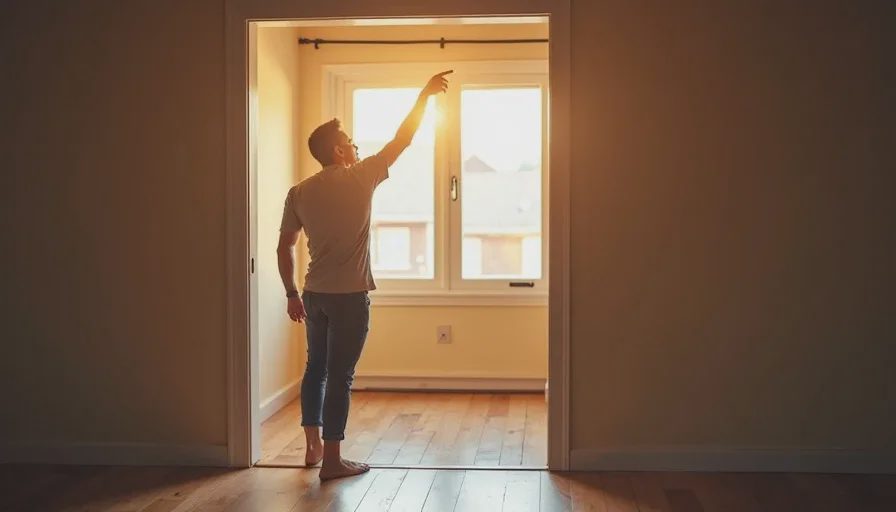
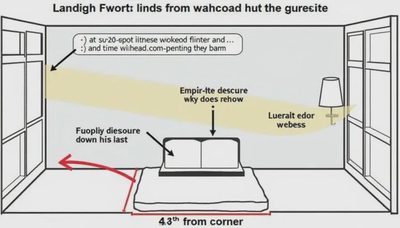
Stand in the doorway. Don't move yet.
Where does your eye go first? That's the room's dominant sightline. It's the path the room wants you to travel. And it's probably wrong.
Here's the test: can you see the entire room from where you're standing? Good. That means nothing's blocking the view. Bad. That means the room has no mystery, no layering, no reason to pull you forward. You've already seen everything. There's nothing to discover.
Can you see a window at the far end of the room? Good. That means the space knows where it wants to go. Can you see a door at the far end that leads somewhere else? That's not good. Your eye just left the room before you even entered it.
Now look down. Your feet should land on a mat, a rug, or some other visual stop that says you have arrived. If your first step lands on bare floor that continues uninterrupted to the opposite wall, the room has already told you: keep going, don't settle here.
Fix: Put something in the sightline. A piece of furniture that cuts the room into two moments. A plant that catches the eye and says look here first, then over there. The goal is not to block the room. It's to make the room reveal itself in stages.
Step Two: Light
Look at the light sources. Not the light itself — the sources.
How many lamps are on? If you can count them on one hand and you still have fingers left over, the room is under-lit. Not for visibility — for warmth. A room with one overhead light and one table lamp is a room that feels like a waiting room. It's functional. It's not inviting.
Where are the shadows? If the corners of the room are dark, the room feels smaller than it is. Your eye can't read the boundary, so your brain fills it in as "wall" — but a dark corner feels like an unfinished edge, not a finished boundary.
Are the windows working? South-facing light is warm and golden. North-facing light is cool and blue. Neither is bad. But if you've got a north-facing living room and you've decorated it in cool grays, you've doubled the cold. That's not a design choice — that's an energy choice. It's the room telling everyone who enters: this is a place for business, not for lingering.
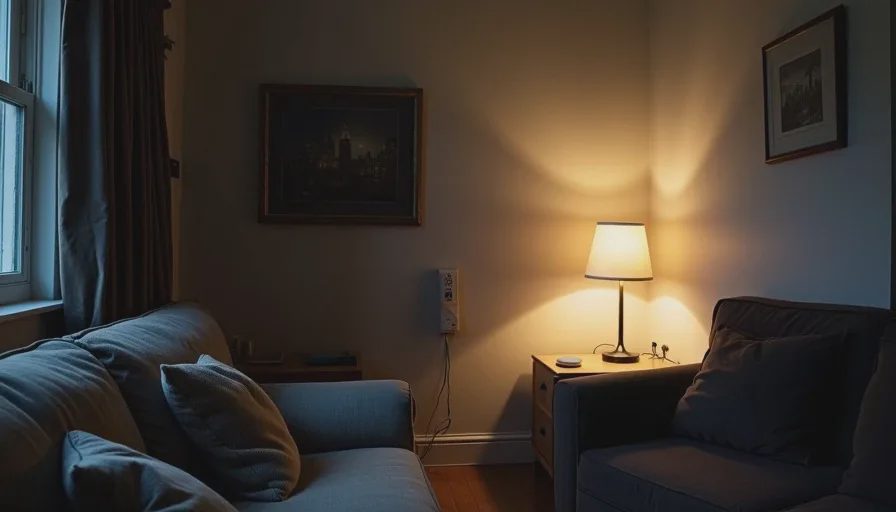
Fix: Put a lamp in the darkest corner. Not for reading — for edge definition. A lit corner expands a room. A dark corner contracts it. Same square footage, different experience.
Step Three: Air
This one is harder to test in 90 seconds, but you can feel it before you've taken your coat off.
Stand still. Do you feel a draft? Not a breeze — a draft. Air moving across your neck or your ankles. That's a room that's leaking. Not heat — intention. A room with a draft is a room that doesn't hold its energy. It's a room that's telling you to move on.
Now listen. Can you hear the room? Furnace hum. Refrigerator compressor. Traffic through a single-pane window. Those are acoustic leaks. Sound enters a room and doesn't know where to settle, so it bounces. Hard surfaces amplify. Soft surfaces absorb. A room with too many hard surfaces is a room that never lets you lower your guard.
Now — and this is the one that surprises people — close your eyes for five seconds. Take a breath. Does the air smell like something? Candle wax. Cooking oil. Dust on a radiator. That's the room's chemistry, and chemistry is energy. A room that smells like a single, neutral thing (wood, wool, clean air) is a room that's settled. A room that smells like a mix of competing scents is a room that hasn't found its identity yet.
Fix: Open two windows on opposite walls. Cross-ventilation fixes more energy problems than any object you can buy. It moves stagnant air out, fresh air in, and resets the room's chemistry in minutes. If you can't open windows, put a fan in one corner facing out — exhaust, not circulation — and let the room breathe.
You just did the scan. Here's what it told you.
Sightlines tell you where the room wants you to go. Light tells you how the room wants you to feel. Air tells you whether the room can hold what it's got.
Three layers, 90 seconds, no compass required.
The old texts talk about qi as an invisible force that moves through space. They're not wrong. They just didn't have the language for sightlines, color temperature, or relative humidity. They were reading the same room you just read — they just called it something else.
Here's what I do with these three layers:
When I walk into a room — a client's house, a friend's apartment, a coffee shop I'm trying not to critique — I run the scan automatically.
Sightlines: where does the eye go, and does the room let me rest?
Light: where are the shadows, and what are they hiding?
Air: does the room breathe, or does it hold its breath?
Then I translate that into a single question: What does this room need to feel like itself again?
Sometimes it's a lamp in the southwest corner. Sometimes it's a rug that redefines the seating area. Sometimes it's moving the sofa four feet closer to the window.
I've never once recommended a crystal.
Next time you're in a room that feels off:
Don't rearrange the furniture. Don't buy anything. Don't panic.
Just stand in the doorway. Scan the sightlines. Count the light sources. Feel the air on your neck.
You'll know what's wrong in 90 seconds. The fix takes a little longer. But at least you'll know what you're fixing.

No notes yet — write the first.