
I went to a housewarming last spring.
New house. New couple. New everything. The kind of party where everyone brings wine, because that's what you bring to a housewarming. It's the default. It's safe. It's also the most useless gift you can give.
I arrived with a bottle of red. I walked in, handed it over, and immediately started doing what I always do: reading the room. Not the people. The space.
The living room was huge. Vaulted ceiling. Floor-to-ceiling windows on the south wall. Beautiful. But the sound was wrong. It bounced. Hard surfaces everywhere — tile floor, glass windows, no rugs, no curtains. The room looked like a magazine and sounded like a gymnasium. Every conversation was a competition.
The entryway had no surface. Nothing to put keys on, nothing to drop a bag on. Just a bare floor and a blank wall. The couple had been there for three weeks and hadn't figured out where to put their stuff. They were living out of pockets.
The kitchen had an island. Beautiful. But the island had no lighting above it. The overhead lights were on the perimeter, so the center of the kitchen was dark. Anybody chopping vegetables was working in their own shadow.
I looked at the wine in my hand. I looked at the room. I realized I'd brought the wrong thing.
I excused myself, drove to the nearest home goods store, and came back twenty minutes later with a different gift. A large ceramic bowl, a simple wooden tray, and a warm-toned floor lamp with a paper shade.
I set the bowl on the island. It caught the light and reflected it. The kitchen suddenly had a center.
I put the tray on the entryway floor. It wasn't a table — it was a destination. Keys go here. Mail goes here. The entryway had a job.
I put the lamp in the corner of the living room, pointed it at the ceiling, and turned it on. The room changed. The sound didn't change — that's a different fix — but the feel changed. The room had a focal point. It had a presence.
The couple was confused. They'd gotten ten bottles of wine that night. They'd also gotten a room.
I could have brought a better bottle of wine. Instead, I gave their house what it needed.
Why Wine Is the Wrong Default
I'm not anti-wine. I drink wine. I've given wine. It's a fine gift.
But wine doesn't read the room. Wine is a gift for the person, not the space. And a housewarming is a gift for the house. The person is just the reason you're there. The house is the client.
Think about what you're doing when you bring wine to a housewarming. You're saying "I thought of you." That's nice. But you're not saying "I thought of your space." And the space is what needs attention.
Most people move into a new house and spend the first six months figuring out what's wrong with it. They don't know what's wrong. They just know something is off. The bedroom is too bright. The living room echoes. The kitchen feels sterile. They try to fix it by buying things, but they don't know what to buy, so they buy decor — candles, throw pillows, art that doesn't quite fit.
A housewarming gift that reads the room skips that six-month period. It identifies the problem and fixes it on day one.
The Five-Minute Spatial Assessment
You can do this at any housewarming. You don't need a tape measure. You don't need a floor plan. You just need to pay attention for five minutes.
Here's the sequence:
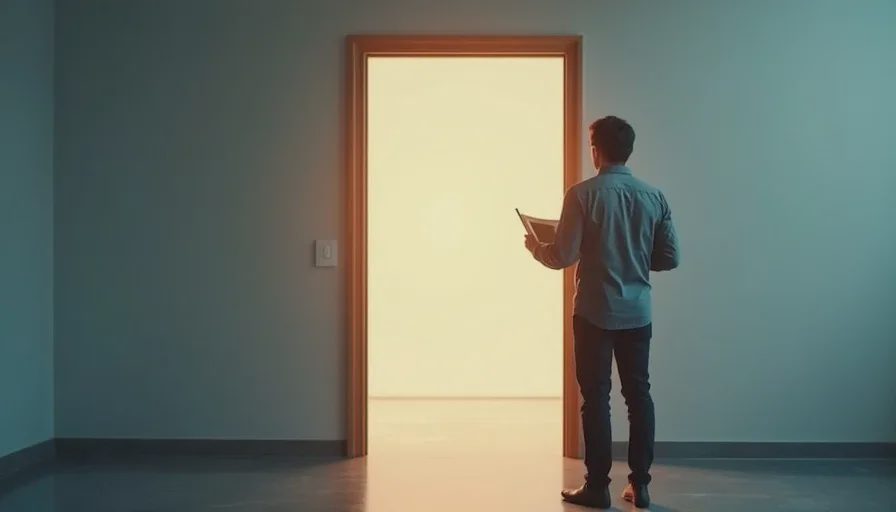
Step One: Stand in the doorway and don't move.
Look at the entryway. Is there a surface to put something on? Is there a light that's warm and inviting? Is there a place to sit or pause?
If the entryway is bare, the house is saying "I don't know how to welcome." If the entryway is cluttered, the house is saying "I don't know how to organize." If the entryway has a warm light and a surface, the house already knows how to greet.
Step Two: Walk into the living room and listen.
Close your eyes for a moment. Just listen. Does the sound bounce? Does it feel like you're in a cave or a cathedral? Hard surfaces reflect sound. Soft surfaces absorb it. A room with too many hard surfaces is a room that's never at rest. A room with too many soft surfaces is a room that feels heavy.
If the sound bounces, the room needs textiles. A rug. Curtains. A throw. If the sound is dead, the room needs hard surfaces to break up the density.
Step Three: Look at the light.
Not the fixtures. The light. Are there lamps that point down? Are there lamps that point up? Is the light warm or cool? Is there a light on the ceiling or only on the walls?
A room with only overhead light is a room that's being interrogated. A room with only wall light is a room that's hiding. A room with both has balance.
Now look at the corners. Are the corners dark? Dark corners make rooms feel smaller. A room with lit corners feels larger. Count the dark corners. That's how many lamps you need.
Step Four: Walk through the kitchen.
Look at the surfaces. Where do you put something down? A countertop doesn't count — it's for work. A table counts. An island counts. A shelf counts. Anywhere you can put something without blocking the work surface is a landing zone.
Count the landing zones. If there are fewer than three, the kitchen is under-resourced. If there are more than five, the kitchen is over-resourced and likely cluttered.
Now look at the sink. Is the sink facing a window or a wall? If it's facing a wall, the kitchen is missing an opportunity. The sink is where you stand for the longest time. If you're staring at a wall, you're not engaged with the room.
Step Five: Stand in the middle of the room.
Take one full breath. Slow. Deep. Where does your breath want to go? Does it want to go up? The room needs verticality — something that draws the eye to the ceiling. Does it want to go sideways? The room needs horizontality — something that opens the sightline.
Your body knows what the room needs. You just have to listen to it.
What to Buy Based on What You See
Here's the cheat sheet:
You Notice | The Room Needs | What to Buy |
|---|---|---|
Bare entryway | Welcome | A tray, a bowl, or a small lamp |
Echoing sound | Absorption | A rug, thick curtains, or a fabric wall hanging |
Dark corners | Warmth | A floor lamp with an uplight shade |
Harsh overhead light | Softness | A table lamp with a warm bulb |
No surfaces in kitchen | Landings | A wooden board, a ceramic plate, or a small tray |
Sink facing a wall | View | A plant, a mirror, or a piece of art above the sink |
Energy feels stuck | Movement | A mobile, a hanging sculpture, or a plant that reaches up |
Energy feels scattered | Anchor | A stone, a ceramic vessel, or a heavy book |
The Gift Is the Assessment
This is the thing I want you to understand.
The housewarming gift isn't the lamp or the bowl or the tray. The housewarming gift is the assessment. You're doing something most people never do: paying attention to a space and responding to it.
The lamp is just the delivery method.
When you hand someone a gift that fixes a problem they didn't know they had, you're not giving them an object. You're giving them permission to see the room differently. They've been living in a space that felt off, and you just named it. You just gave it a language.
That's not a housewarming. That's a diagnosis.
The Housewarming I Still Remember
The best housewarming gift I ever received was a single rock.
Not a polished stone. Not a crystal. A rock. Rough. Grey. Heavy. Found at the edge of a creek somewhere.
It was from a friend who knew me well. She put it on the floor in a corner of my new house and said "this corner has no energy. The rock will give it something to hold."
I didn't believe her. I also didn't move the rock.
Six years later, it's still there. That corner is where I put my keys. It's where I stand when I'm thinking. It's where I stop before I leave.
The rock didn't fix anything. But it started something. It gave the corner a reason to exist.
I don't remember what wine I got that year. I remember the rock.
The Protocol for Your Next Housewarming
Here's what I do now.
I bring a gift bag. In the gift bag, I bring one thing: a blank notebook and a pen.
I walk into the house. I spend five minutes doing the assessment. I write down what I see: "entryway needs a surface," "southwest corner is dead," "kitchen island has no light."
Then I go to a store or order online. I buy the thing the room needs. I wrap it and deliver it the next day.
The notebook is my conversation starter. I hand it to the new homeowner and say "here's what I saw." Not as a criticism — as a reading.
Every single person has been grateful. Not because I fixed something. Because I paid attention to their space. Because I treated their house like it mattered.
The One You Can't Buy
The most important housewarming gift isn't something you can buy.
It's this: the permission to trust what you feel.
New homeowners spend months rearranging, second-guessing, buying things that don't quite work. They know something is off. They just don't know what. If someone walks in and names the problem, they can start fixing it.
You don't need to buy a lamp. You just need to say: "This corner is too dark. It needs something warm." And you've just given them permission to buy the lamp they were too uncertain to buy.
That's the housewarming gift that reads the room first. Not an object. A diagnosis.
And it's free.
June came to a housewarming with me once. She was eight. She walked into the house, looked around for thirty seconds, and said: "The kitchen feels sad."
The owner laughed. Then she looked at her kitchen. She'd been unhappy with it for months but couldn't figure out why. June had just named it.
I didn't buy anything that night. I just watched June be honest. And I saw the owner look at her kitchen differently.
The name is the gift. The rest is just shopping.

No notes yet — write the first.